

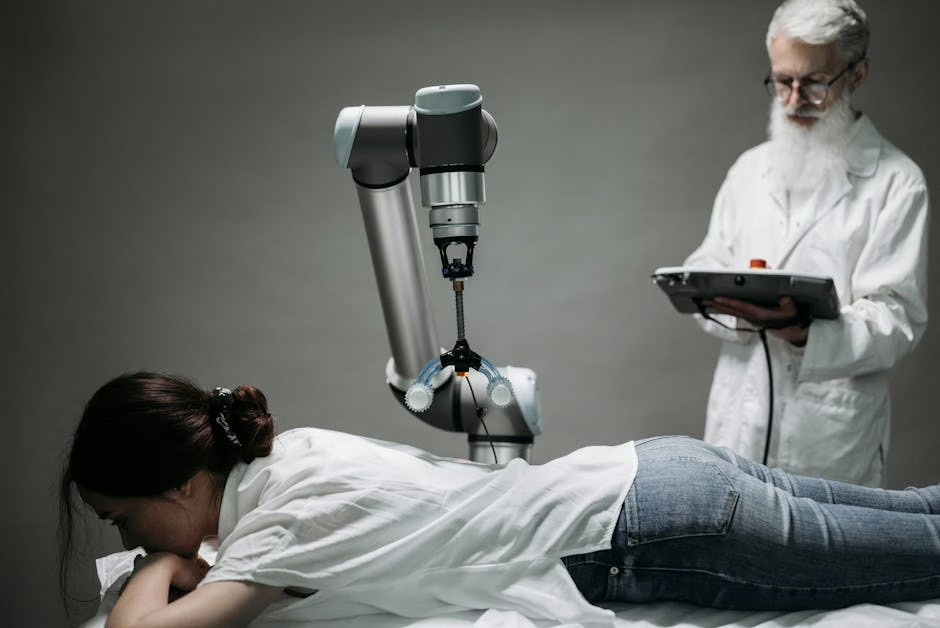

AI-Driven Healthcare Solutions Advance Clinical Workflows
The healthcare sector is experiencing a significant transformation as artificial intelligence technologies mature beyond experimental phases into production-ready clinical applications. Recent developments demonstrate how AI architectures are being integrated into healthcare delivery systems, addressing critical challenges in physician accessibility and clinical process optimization.
Scaling Primary Care Through AI-Assisted Platforms
Mass General Brigham’s Care Connect program represents a notable advancement in AI-assisted healthcare delivery architecture. The system employs machine learning algorithms to augment remote physician capabilities, enabling practitioners to efficiently manage 40-50 patient consultations daily through an integrated AI platform.
The technical implementation combines natural language processing for patient intake optimization with decision support systems that assist physicians in triaging urgent care needs. This hybrid human-AI architecture addresses the critical physician shortage crisis in Massachusetts and New Hampshire by amplifying clinician productivity through intelligent workflow automation.
The program’s expansion methodology involves scaling both the AI infrastructure and clinical workforce simultaneously, suggesting a sustainable model for addressing healthcare access challenges through technology augmentation rather than replacement.
Dynamic Clinical Process Mapping Through AI
Traditional clinical process map development has historically suffered from lengthy development cycles and static implementation frameworks. Arcadia’s approach to modernizing these systems leverages AI to transform static clinical guidelines into adaptive, real-time decision support tools integrated directly within electronic health record (EHR) systems.
The technical architecture employs machine learning algorithms to continuously update clinical pathways based on evolving medical evidence. This represents a significant advancement from rule-based systems to adaptive frameworks that can incorporate new research findings and adjust treatment protocols dynamically.
Logan Masta’s work at Arcadia demonstrates how AI can bridge the gap between clinical evidence generation and practical implementation, reducing the traditional months-long development cycles to near real-time updates. The system architecture enables evidence-based care delivery at scale by automating the translation of clinical research into actionable EHR workflows.
Technical Implications for Healthcare AI
These developments highlight several key technical advances in healthcare AI implementation:
Hybrid Intelligence Architecture: The integration of AI with human clinical expertise demonstrates a maturing understanding of optimal human-machine collaboration models. Rather than pursuing full automation, these systems augment human capabilities while maintaining clinical oversight.
Real-Time Adaptation: The shift from static to dynamic clinical systems represents a fundamental architectural evolution, enabling healthcare AI to respond to new evidence and changing clinical requirements without manual system updates.
Scalable Integration: Both implementations demonstrate successful integration with existing healthcare infrastructure, suggesting that AI healthcare solutions are reaching production-ready maturity levels.
Future Implications
The convergence of AI-assisted clinical delivery and dynamic process optimization suggests a broader trend toward adaptive healthcare systems. These implementations provide technical frameworks that could be extended to address other healthcare challenges, from specialist consultations to complex treatment planning.
The success of these pilot programs indicates that healthcare AI is transitioning from research prototypes to scalable production systems, with measurable impacts on clinical workflow efficiency and patient access.
As these technologies continue to mature, we can expect to see further integration of machine learning algorithms into core healthcare delivery systems, potentially transforming how clinical care is delivered and optimized across the healthcare continuum.
Further Reading
- Report: Anthropic cuts off xAI’s access to Claude models for coding – Reddit Singularity
- How AI Is Reshaping Healthcare—And Where VC Is Placing Its Bets – Forbes Tech
- How to get ‘responsible AI’ right – Healthcare IT News
