


The Rapidly Evolving Landscape of AI and Semiconductor Technology
Skyrocketing Standards in AI Model Performance
The artificial intelligence industry has witnessed an unprecedented acceleration in performance expectations over the past year. What was once considered groundbreaking technology is now often dismissed if it doesn’t significantly outperform established models—even when the comparison isn’t entirely fair.
A recent discussion highlighted how QwQ, an open-source AI model capable of running on a single consumer-grade GPU (specifically a 3090), is being criticized despite outperforming Claude 3.7 Sonnet in certain metrics. The remarkable aspect isn’t just the performance but the cost differential—with commercial alternatives like GPT-4.5 reportedly costing up to 428 times more to operate.
This phenomenon reflects a fundamental shift in how we evaluate AI systems. The goalposts for what constitutes a “good” model have moved dramatically, with some industry observers noting that unless a new model “crushes frontier models at a fraction of the cost,” it risks being labeled as inadequate.
The Moat Problem in AI Startups
This rapid evolution presents significant challenges for entrepreneurs looking to establish new AI companies. Even industry leaders like OpenAI and Anthropic face the reality that their technological advantages—built with tens of millions in investment—can be partially replicated by competitors.
The case of DeepSeek demonstrates how training on the outputs of powerful commercial language models can achieve reasonably similar results at lower costs. This raises a critical question: If established AI powerhouses must constantly worry about their technological edge being eroded, what hope exists for new entrants?
Investors in the AI space suggest that startups focusing on specialized agents or agentic workflows for specific use cases can still build profitable businesses with healthy margins. However, this strategy comes with considerable risk, as these startups often rely heavily on commercial LLM APIs, making them vulnerable to rapid industry changes and potential disruption.
The Semiconductor Supply Chain: China’s Bold Strategy
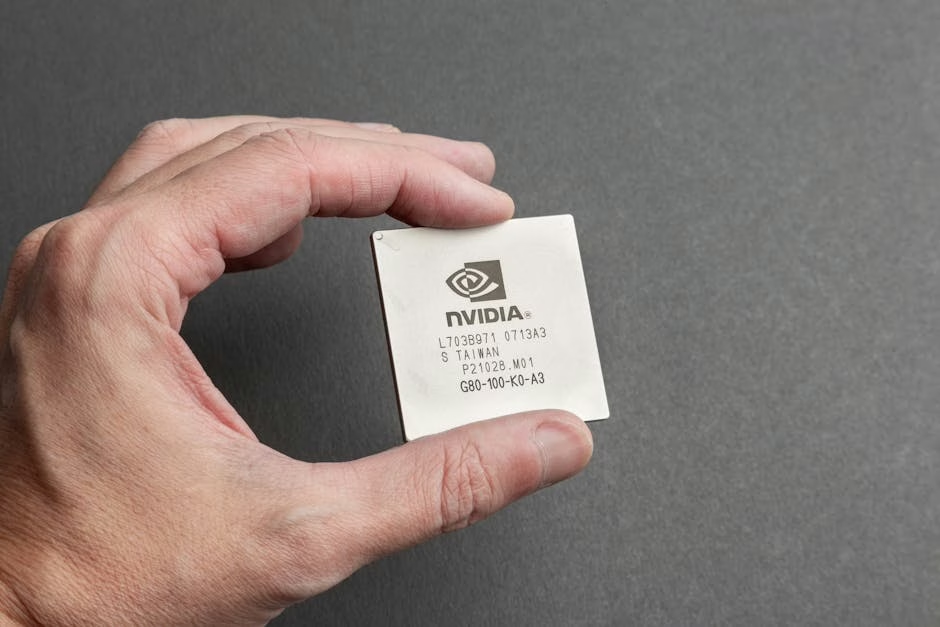
Parallel to the AI software race, a critical hardware battle is unfolding in the semiconductor industry. China is undertaking what some analysts describe as an “insane but strategic” effort to develop its entire semiconductor supply chain domestically.
This ambitious initiative spans approximately 10-12 provinces and municipalities, leveraging about 40% of China’s population (roughly 571 million people) to create a self-sufficient ecosystem for chip production. The country is essentially functioning as a continent-sized economy, with provincial units specializing in different aspects of the supply chain.
The strategy comes in response to restrictions imposed by the US, EU, Japan, and Taiwan bloc, which collectively control a complete semiconductor supply chain despite representing only about two-thirds of China’s population. China’s approach highlights how population and market size, rather than just land resources, can potentially enable such large-scale industrial self-sufficiency.
A Paradigm Shift in Technology Development
Underlying these developments is what some researchers have identified as a paradigm shift in how AI systems approach reasoning and problem-solving. This evolution in model capabilities is reshaping expectations across the industry and driving both the software and hardware races.
As these trends continue to unfold, they will likely redefine not just the technological landscape but also geopolitical relationships and economic structures around the globe. The intersection of AI advancement and semiconductor production represents one of the most consequential technological competitions of our time, with far-reaching implications for innovation, national security, and economic prosperity.
Sources
- The paradigm shift of reasoning models – Reddit Singularity
- China is basically trying to produce the entire semiconductor supply chain domestically – Reddit Singularity