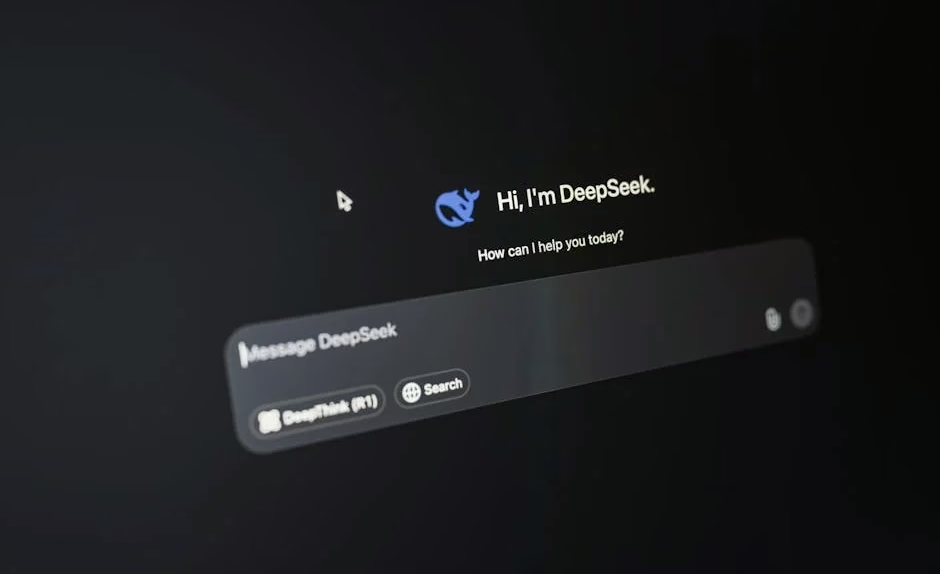

DeepSeek released its V4 model on Monday, delivering near state-of-the-art performance at one-sixth the cost of proprietary alternatives like Claude Opus 4.7 and GPT-5.5. The 1.6-trillion-parameter model arrives alongside new open source releases from Xiaomi, marking a significant shift toward accessible, enterprise-ready AI systems.
According to VentureBeat, DeepSeek-V4 matches or exceeds closed-source systems on multiple benchmarks while offering API pricing at $0.14 per million input tokens and $0.28 per million output tokens. The model is available under the MIT License on Hugging Face and through DeepSeek’s API.
https://x.com/deepseek_ai/status/2047516922263285776
DeepSeek-V4 Performance and Pricing
The Mixture-of-Experts architecture delivers frontier-class capabilities at dramatically reduced costs. DeepSeek AI researcher Deli Chen described the release as a “labor of love” 484 days after V3’s launch, emphasizing that “AGI belongs to everyone.”
Benchmark results show DeepSeek-V4 competing directly with GPT-5.5 and Claude Opus 4.7 across reasoning, mathematics, and coding tasks. The model’s API pricing represents an 83% cost reduction compared to Anthropic’s Claude Opus 4.6, which charges $5 per million input tokens and $25 per million output tokens.
The release includes comprehensive documentation and integration guides for developers. Enterprise users can deploy the model locally or through cloud infrastructure, with full commercial licensing under the MIT framework.
Xiaomi MiMo Models Excel at Agentic Tasks
Xiaomi simultaneously launched MiMo-V2.5 and MiMo-V2.5-Pro, specifically optimized for agentic “claw” applications. VentureBeat reported that both models lead the open source field in efficiency for systems like OpenClaw, NanoClaw, and Hermes Agent.
The Pro version achieved a 63.8% success rate on ClawEval benchmarks while using fewer tokens than competing models. This efficiency translates to lower operational costs for businesses deploying AI agents for marketing automation, email management, and scheduling tasks.
Both models are available on Hugging Face under the MIT License. The permissive licensing allows modification and commercial deployment without restrictions.
https://x.com/xiaomimimo/status/2048821516079661561
OpenAI Contributes Privacy Filter Tool
OpenAI released Privacy Filter, a 1.5-billion-parameter model designed to detect and redact personally identifiable information from datasets. The tool runs on standard laptops or web browsers, addressing enterprise concerns about data privacy in AI workflows.
According to VentureBeat, Privacy Filter uses a bidirectional token classifier architecture derived from OpenAI’s gpt-oss family. The Apache 2.0 license enables unrestricted commercial use.
The model processes text locally before cloud transmission, preventing sensitive data exposure during training or inference. This “privacy-by-design” approach supports compliance with regulations like GDPR and CCPA.
Enterprise Adoption Accelerates
Google Cloud documented 1,302 real-world generative AI use cases across leading organizations, demonstrating widespread enterprise adoption. The Google Blog post highlights agentic AI deployments using tools like Gemini Enterprise and Security Command Center.
Production AI systems now operate across thousands of organizations, with many leveraging open source models for cost control and customization. The shift toward open source reflects enterprise demands for transparency, security, and vendor independence.
Cost Considerations Drive Open Source Migration
Towards Data Science reported that developers are migrating from proprietary APIs due to pricing pressures. Anthropic’s restriction of Claude subscriptions for OpenClaw usage forced users to seek alternatives.
Chinese models like Kimi-K2.5 and GLM-5.1 provide comparable performance at lower costs. API pricing for open source alternatives ranges from $0.10 to $0.50 per million tokens, compared to $5-25 for premium proprietary models.
Technical Architecture and Capabilities
DeepSeek-V4’s Mixture-of-Experts design activates specific parameters based on input complexity, optimizing computational efficiency. The model supports 1-million-token context windows and multilingual processing across 100+ languages.
Xiaomi’s MiMo models feature specialized training for multi-step reasoning and tool usage. The architecture includes function calling capabilities and integration APIs for third-party services.
Deployment and Integration Options
All models support multiple deployment scenarios:
- Local deployment: Run on enterprise hardware with full data control
- Private cloud: Deploy on AWS, Azure, or Google Cloud with custom configurations
- Hybrid systems: Combine local inference with cloud-based fine-tuning
- Edge computing: Optimized versions for mobile and IoT applications
Developers can access pre-built Docker containers, Kubernetes manifests, and integration libraries through respective model repositories.
What This Means
The simultaneous release of high-performance open source models from DeepSeek, Xiaomi, and OpenAI signals a fundamental shift in AI accessibility. Enterprise organizations now have viable alternatives to expensive proprietary systems without sacrificing capability.
This democratization of AI technology reduces barriers to entry for startups and smaller organizations. The MIT and Apache 2.0 licenses enable unrestricted commercial use, fostering innovation and competition.
The focus on specialized capabilities—DeepSeek’s general intelligence, Xiaomi’s agentic efficiency, and OpenAI’s privacy tools—suggests the market is maturing beyond general-purpose models toward task-specific solutions.
FAQ
Q: How does DeepSeek-V4’s performance compare to GPT-5.5 and Claude Opus 4.7?
A: DeepSeek-V4 matches or exceeds these proprietary models on most benchmarks while costing approximately 83% less through API access. The model particularly excels in mathematical reasoning and coding tasks.
Q: Can these open source models be used commercially without restrictions?
A: Yes, all mentioned models use permissive licenses (MIT or Apache 2.0) that allow commercial use, modification, and redistribution without royalties or usage restrictions.
Q: What hardware requirements are needed to run these models locally?
A: DeepSeek-V4 requires high-end GPU infrastructure due to its 1.6T parameters, while Xiaomi MiMo models and OpenAI’s Privacy Filter can run on standard enterprise hardware or even laptops for smaller tasks.
Related news
Sources
- Open source Xiaomi MiMo-V2.5 and V2.5-Pro are among the most efficient (and affordable) at agentic ‘claw’ tasks – VentureBeat
- DeepSeek-V4 arrives with near state-of-the-art intelligence at 1/6th the cost of Opus 4.7, GPT-5.5 – VentureBeat
- How to Run OpenClaw with Open-Source Models – Towards Data Science