
Defense tech firm Anduril raised $5 billion in a new funding round on May 13, 2026, doubling its valuation to $61 billion — one of the largest private defense-AI rounds on record. The same week, SoftBank confirmed a $457 million injection into British AI chip maker Graphcore, OpenAI launched a new enterprise deployment subsidiary, and cybersecurity AI investment hit levels not seen in years. Taken together, the moves signal a broad acceleration in institutional capital flowing into AI infrastructure, defense, and enterprise software.
Anduril Hits $61 Billion Valuation After $5B Round
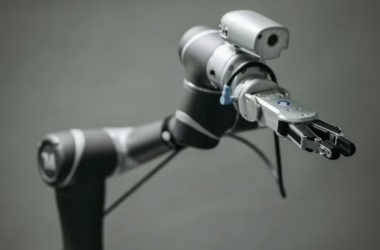
Anduril Industries closed a $5 billion funding round led by Thrive Capital and Andreessen Horowitz, according to CNBC, pushing its post-money valuation to $61 billion — double its previous mark. The Palmer Luckey-founded startup builds autonomous weapons systems, surveillance hardware, and AI-driven defense platforms for the U.S. military and allied governments.
CEO Brian Schimpf said the company would “aggressively” invest in manufacturing, research, and infrastructure to support U.S. defense systems, per CNBC’s reporting. The round reflects sustained investor appetite for defense-adjacent AI companies at a moment when U.S. government spending on autonomous systems has expanded significantly.
Anduril’s fundraise is the largest disclosed private defense-tech round of 2026 so far. It also underscores how AI capabilities — particularly autonomy, computer vision, and real-time decision systems — have become central to the investment thesis for defense startups, not just a feature add-on.
SoftBank Puts $457M Into Graphcore
SoftBank has funneled $457 million into Graphcore, the Bristol-based AI chip company it acquired in 2024, Graphcore confirmed to CNBC. The capital infusion is part of SoftBank’s broader push into AI infrastructure and hardware, with the Japanese conglomerate positioning Graphcore’s Intelligence Processing Units (IPUs) as an alternative to NVIDIA’s GPU-dominant stack.
SoftBank has stated that Graphcore will collaborate on developing artificial general intelligence (AGI) — broadly defined as AI that matches or surpasses human cognitive performance across domains. That framing aligns with SoftBank CEO Masayoshi Son’s long-running public thesis that AGI is imminent and will require purpose-built silicon.
The injection is notable for its size relative to Graphcore’s market position. The company has struggled to gain meaningful share against NVIDIA in the data center market, and the fresh capital suggests SoftBank is doubling down rather than winding down its chip hardware ambitions. Whether Graphcore’s IPU architecture can compete at scale against H100 and B200 deployments remains an open question the funding alone cannot resolve.
OpenAI Launches Deployment Subsidiary, Eyes Enterprise
OpenAI announced the formation of the OpenAI Deployment Company, a new venture designed to accelerate AI onboarding for enterprise customers, according to CNBC. The announcement came alongside remarks from Chief Revenue Officer Denise Dresser, who described enterprise AI adoption as being “at a tipping point.”
Dresser’s comments reflect competitive pressure from Google and Anthropic, both of which have deepened enterprise sales motions in recent months. OpenAI’s new deployment entity appears aimed at shortening the time between a company signing an enterprise agreement and actually having AI integrated into workflows — a gap that has historically been a friction point for large-scale rollouts.
The move also comes as OpenAI’s legal and corporate structure faces scrutiny. The Musk v. Altman trial, ongoing in May 2026, centers partly on whether OpenAI’s commercial expansion — including its relationship with Microsoft — violated the terms of its original nonprofit charter. Microsoft CEO Satya Nadella testified on May 11, 2026, stating that Elon Musk never raised concerns with him personally about Microsoft’s investment in OpenAI, per CNBC. Musk has accused Microsoft of aiding and abetting OpenAI’s alleged breach of charitable trust.
Cybersecurity AI Investment Outpaces M&A in Q1 2026
A separate but related trend is playing out in cybersecurity. Investment in security startups exceeded the total value of mergers and acquisitions in Q1 2026 by more than $1 billion — a rare inversion, according to a report from security investment bank Momentum Cyber cited by Dark Reading.
Momentum Cyber tracked 108 M&A deals in the quarter, but the average deal size was small. Investors are instead placing larger bets on AI-native security startups, particularly those building on large language model capabilities for threat detection, automated response, and vulnerability analysis.
The ‘Valley of Death’ Problem
Dark Reading described the dynamic as widening a “valley of death” — the gap between early-stage funding and the scale needed to reach acquisition or IPO. When investment dollars flood into many small companies simultaneously, the acquisition market fragments. Buyers have more targets but less urgency to pay premium prices, while startups face longer runways to profitability.
The report attributed part of the investment surge to the preview of Anthropic’s Project Glasswing (part of the Mythos initiative), which produced what Dark Reading called “seismic” effects on security investment sentiment. The preview appears to have convinced investors that AI-native security tools are not a future category but a present necessity — accelerating capital deployment into the sector.
Noise vs. Signal for CISOs
For chief information security officers, the flood of AI-focused security vendors creates a practical problem: more vendors claiming AI capabilities, fewer clear differentiators, and limited time to evaluate them. Dark Reading noted that the same AI capabilities attracting investment are also enabling more sophisticated attacks, meaning CISOs face pressure from both sides — evaluating new defensive tools while managing an expanding threat surface.
What This Means
The week of May 11–14, 2026 illustrates how AI investment has stopped being a discrete category and started functioning as the primary driver of capital allocation across defense, hardware, enterprise software, and cybersecurity simultaneously.
Anduril’s $5 billion raise at a $61 billion valuation is not just a defense story — it reflects investor conviction that AI-driven autonomy is a durable government procurement priority, not a cyclical budget item. SoftBank’s $457 million into Graphcore is a hardware bet that the GPU monoculture around NVIDIA will eventually face credible competition, even if Graphcore hasn’t yet proven it can deliver at scale.
OpenAI’s deployment subsidiary signals that the company recognizes a structural gap between selling enterprise licenses and actually generating sticky, recurring revenue from embedded AI workflows. That gap is where Google and Anthropic are also competing aggressively, and the formation of a dedicated deployment entity suggests OpenAI believes organizational structure — not just model quality — is a competitive variable.
The cybersecurity data point is perhaps the most structurally interesting: when investment consistently outpaces M&A value, it typically means the market hasn’t consolidated around winners yet. That’s an opportunity for well-capitalized startups and a warning for those burning runway in a crowded field.
FAQ
What is Anduril Industries and why did its valuation double?
Anduril Industries is a defense technology company founded by Palmer Luckey that builds autonomous weapons systems, AI-driven surveillance platforms, and defense infrastructure for the U.S. military. Its valuation doubled to $61 billion after closing a $5 billion funding round led by Thrive Capital and Andreessen Horowitz in May 2026, reflecting strong investor demand for AI-enabled defense capabilities.
What is the OpenAI Deployment Company?
The OpenAI Deployment Company is a new subsidiary announced by OpenAI in May 2026, designed to accelerate the integration of AI tools into enterprise business workflows. Chief Revenue Officer Denise Dresser described the launch as a response to a “tipping point” in enterprise AI adoption, with the entity aimed at reducing friction between contract signing and active AI deployment.
Why did cybersecurity investment outpace M&A value in Q1 2026?
According to a Momentum Cyber report cited by Dark Reading, investment in cybersecurity startups exceeded total M&A deal value by more than $1 billion in Q1 2026, despite 108 acquisition deals closing in the quarter. The gap reflects investor preference for placing large bets on AI-native security startups rather than acquiring them, a dynamic analysts describe as widening the “valley of death” between early funding and exit.
Sources
- OpenAI trial: Nadella says Musk never raised concerns to him about Microsoft investment – CNBC Tech
- AI Drives Cybersecurity Investments, Widening ‘Valley of Death’ – Dark Reading
- Anduril doubles valuation to over $60 billion as defense tech funding boom continues – CNBC Tech
- OpenAI revenue chief Dresser says enterprise AI adoption is ‘at a tipping point’ – CNBC Tech
- SoftBank has injected $450 million into this British AI chip company – CNBC Tech