
Uber has committed over $10 billion to autonomous vehicle technology and equity stakes in self-driving companies, marking a dramatic shift toward asset-heavy investments in the rapidly evolving automotive AI landscape. According to The Financial Times, approximately $2.5 billion represents direct investments, while the remaining $7.5 billion will purchase robotaxis over the coming years.
This massive financial commitment signals how AI is fundamentally transforming the automotive industry, from ride-sharing platforms to manufacturing processes. As traditional automakers race to integrate advanced driver assistance systems (ADAS) and fully autonomous capabilities, the convergence of AI and transportation is creating new opportunities and challenges for consumers and businesses alike.
Uber’s Strategic Pivot to Autonomous Technology
Uber’s current investment strategy represents a significant departure from its previous approach to autonomous vehicles. Between 2015 and 2018, the company pursued in-house development through initiatives like Uber ATG and acquisitions such as Otto and Jump. However, by 2020, Uber divested these assets to focus on its core platform business.
Key investments in Uber’s current autonomous portfolio include:
- WeRide: Chinese autonomous driving technology
- Wayve: UK-based AI driving systems
- Nuro: Last-mile delivery robotics
- Rivian: Electric vehicle manufacturing
- Lucid Motors: Premium EV technology
This time around, Uber is taking a different approach by partnering with established autonomous vehicle developers rather than building technology internally. This strategy allows the company to maintain its asset-light business model while gaining access to cutting-edge self-driving capabilities across multiple vendors.
Tesla and Waymo Lead Consumer-Facing Autonomous Features
While Uber focuses on commercial applications, Tesla and Waymo continue advancing consumer-oriented autonomous driving experiences. Tesla’s Full Self-Driving (FSD) beta program has expanded to hundreds of thousands of users, providing real-world testing data that improves the system’s neural networks.
Tesla’s approach emphasizes:
- Vision-only processing: Eliminating expensive LiDAR sensors
- Over-the-air updates: Continuous improvement without service visits
- User feedback integration: Driver interventions help train the AI
- Familiar interface: Existing Tesla owners can access FSD features
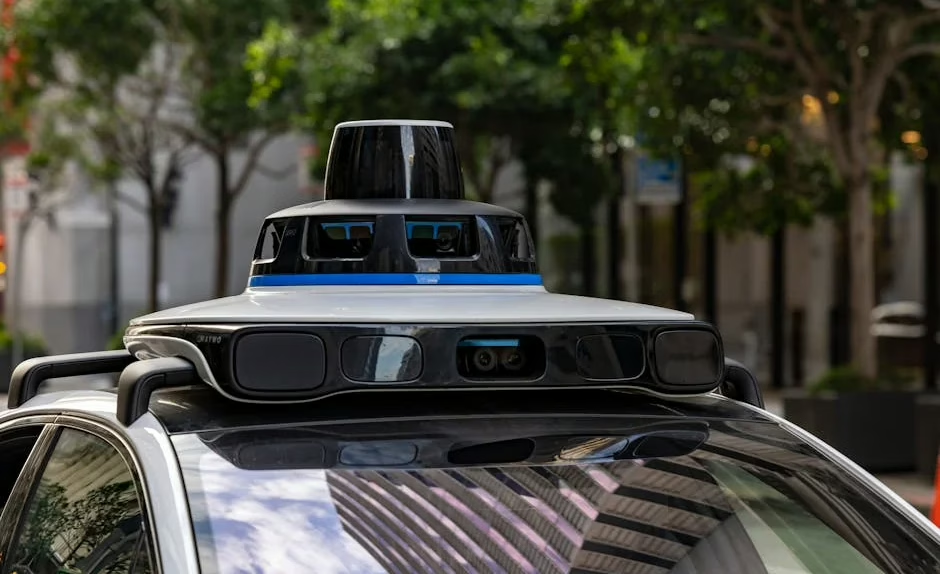
Waymo, meanwhile, operates fully autonomous robotaxis in Phoenix, San Francisco, and Los Angeles. Their service demonstrates how self-driving technology can provide mobility solutions for users who cannot or prefer not to drive traditional vehicles.
ADAS Features Becoming Standard Across All Price Points
Advanced Driver Assistance Systems are rapidly becoming standard equipment rather than premium options. Modern ADAS features use AI to analyze road conditions, detect obstacles, and assist drivers in real-time decision-making.
Common ADAS features now available include:
- Adaptive cruise control: Maintains safe following distances automatically
- Lane keeping assistance: Gentle steering corrections to prevent drift
- Automatic emergency braking: AI detects potential collisions and intervenes
- Blind spot monitoring: Alerts drivers to vehicles in adjacent lanes
- Traffic sign recognition: Displays speed limits and road signs on dashboard
These systems work by combining multiple sensors—cameras, radar, and ultrasonic detectors—with AI algorithms that process information faster than human reflexes. For everyday drivers, this means reduced fatigue during long trips and an extra layer of safety during distracted moments.
Manufacturing Revolution Through AI Integration
Beyond vehicle operation, AI is transforming how cars are designed and manufactured. NVIDIA’s partnerships with automotive manufacturers demonstrate how AI-driven production systems can optimize everything from supply chain management to quality control.
AI applications in automotive manufacturing:
- Predictive maintenance: Sensors monitor equipment health to prevent breakdowns
- Quality inspection: Computer vision identifies defects faster than human inspectors
- Supply chain optimization: AI algorithms predict demand and optimize inventory
- Design simulation: Virtual testing reduces physical prototype requirements
For consumers, these improvements translate to higher build quality, faster delivery times, and potentially lower vehicle costs as manufacturers achieve greater efficiency.
Electric Vehicle Integration Accelerates AI Adoption
Electric vehicles serve as ideal platforms for advanced AI features due to their sophisticated electrical architectures and software-defined capabilities. Unlike traditional internal combustion engines, EVs can dedicate significant computational power to AI processing without compromising performance.
EV advantages for AI implementation:
- Centralized computing: Powerful processors manage multiple vehicle functions
- Over-the-air capabilities: Software updates add new features remotely
- Energy management: AI optimizes battery usage and charging strategies
- Integration potential: Seamless connection with smart home and grid systems
Tesla exemplifies this approach, treating their vehicles as computers on wheels that continuously improve through software updates. Other manufacturers like Ford, GM, and Rivian are adopting similar strategies for their electric lineups.
What This Means
The automotive industry’s AI transformation represents more than technological advancement—it’s reshaping how we think about vehicle ownership, urban mobility, and transportation safety. Uber’s $10 billion commitment signals that autonomous vehicles are moving from experimental technology to commercial reality.
For consumers, this evolution means gradually improving safety features, more convenient transportation options, and vehicles that become smarter over time. However, it also raises questions about data privacy, cybersecurity, and the future role of human drivers.
The convergence of AI, electric powertrains, and autonomous capabilities is creating vehicles that are fundamentally different from their predecessors. Success in this new landscape will depend on companies’ ability to integrate these technologies seamlessly while maintaining user trust and regulatory compliance.
FAQ
How safe are current autonomous driving features?
Current ADAS features significantly improve safety when used properly, but fully autonomous systems like Tesla’s FSD still require driver supervision. Waymo’s commercial robotaxi service represents the most advanced deployment of unsupervised autonomous driving.
Will autonomous vehicles replace human drivers completely?
Full replacement is unlikely in the near term. Autonomous technology will likely coexist with human drivers for decades, with gradual expansion in specific use cases like highway driving, urban robotaxis, and commercial delivery.
How do AI-powered cars protect user privacy?
Manufacturers implement various privacy measures, but practices vary significantly. Tesla processes most data locally, while other companies may upload more information to cloud services. Users should review privacy policies and adjust settings accordingly.