
AI startup funding continues to accelerate in 2025, with OpenAI’s acquisition of personal finance startup Hiro Finance marking the latest strategic move in a competitive market where talent acquisition costs are pushing salaries to $300,000-$500,000 annually. Meanwhile, corporate venture capital firms like TDK Ventures, which has backed three unicorns including Groq, are doubling down on early-stage AI investments as defense tech and robotics companies compete aggressively for specialized talent.
Strategic Acquisitions Drive Market Consolidation
OpenAI’s acquisition of Hiro Finance represents a clear trend toward strategic acquihires in the AI space. According to TechCrunch, the deal brings approximately 10 employees to OpenAI, including founder Ethan Bloch, who previously built and sold Digit to Oportun for over $200 million in 2021.
Key acquisition details:
- Hiro was backed by top-tier VCs including Ribbit Capital, General Catalyst, and Restive
- The startup launched its AI-powered financial planning tool just five months ago
- Terms were not disclosed, but the shutdown timeline suggests an acquihire structure
- OpenAI gains specialized talent in financial AI applications
This acquisition follows OpenAI’s strategy of building domain expertise through targeted talent acquisition rather than organic hiring. The move positions OpenAI to compete more effectively in enterprise financial applications, where ChatGPT already serves business finance teams.
Corporate VCs Lead Early-Stage Investment Wave
Corporate venture capital is emerging as a dominant force in AI startup funding. TDK Ventures, led by president Nicolas Sauvage, has deployed $500 million across 52 startups, achieving three unicorn exits: Groq, Ascend Elements, and Silicon Box.
Corporate VC advantages in AI investing:
- Strategic alignment: Direct access to enterprise customers and distribution channels
- Technical expertise: Deep domain knowledge in hardware and manufacturing
- Patient capital: Longer investment horizons compared to traditional VCs
- Operational support: Access to R&D facilities and manufacturing capabilities
Sauvage’s track record demonstrates how corporate VCs can provide unique value beyond capital. TDK’s portfolio companies benefit from the parent company’s expertise in materials science and electronic components, critical for AI hardware applications.
Talent Wars Reshape Compensation Structures
The AI talent shortage has created unprecedented competition for specialized engineers, particularly those with hybrid skills combining classical robotics and AI expertise. According to industry sources, base salaries for autonomous vehicle engineers now range from $300,000 to $500,000, excluding equity and benefits.
Factors driving salary inflation:
- Defense tech premium: Department of Defense contracts enable higher compensation packages
- Cross-industry demand: Robotics, autonomous vehicles, and industrial AI compete for the same talent pool
- Specialized skills: Integration of AI into physical systems requires rare expertise
- Venture-backed competition: Well-funded startups bid aggressively for key hires
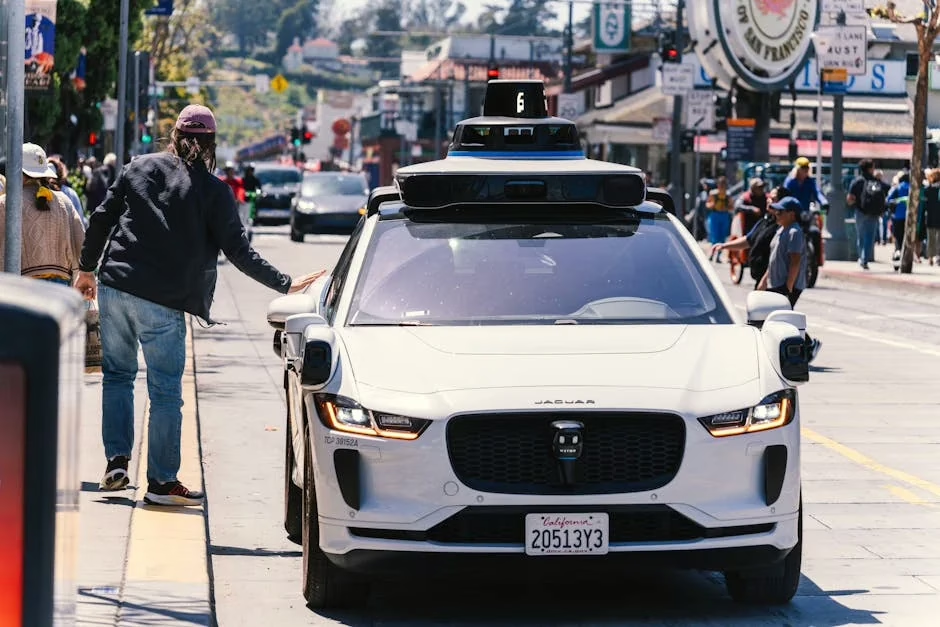
This talent migration poses significant challenges for autonomous vehicle companies like Waymo and traditional automakers. The “knife fight” for talent that characterized the self-driving industry seven years ago has intensified as physical AI applications expand across defense, manufacturing, and logistics.
Stealth Startups Challenge Traditional Launch Models
Slate Auto’s emergence from three years of stealth mode with backing from Jeff Bezos and Mark Walter illustrates how well-funded startups are adopting longer development cycles before public launches. The company’s focus on ultra-low-cost electric pickup trucks starting at $25,000 represents a contrarian bet in an EV market plagued by bankruptcies and failed launches.
Slate Auto’s differentiated approach:
- Cost positioning: $25,000 starting price targets mass market adoption
- Customization focus: Leverages aftermarket expertise from Harley-Davidson and Chrysler alumni
- Stealth development: Three years of R&D before public disclosure
- Strategic location: Troy, Michigan proximity to traditional automakers
The startup’s business model emphasizes customization and aftermarket accessories, potentially creating multiple revenue streams beyond vehicle sales. This approach addresses a key weakness in many EV startups: sustainable unit economics and path to profitability.
Investment Themes Shaping AI Funding Landscape
Several key themes are driving AI startup valuations and funding decisions in 2025:
Physical AI Integration
Investors increasingly favor startups applying AI to physical systems rather than pure software applications. This includes robotics, autonomous vehicles, and industrial automation where AI enables new capabilities in manufacturing, logistics, and defense.
Enterprise-Focused Revenue Models
B2B AI startups demonstrate clearer paths to profitability compared to consumer-focused applications. OpenAI’s acquisition of Hiro reflects this trend, as financial AI tools serve enterprise customers with higher willingness to pay.
Vertical AI Specialization
General-purpose AI models face increasing competition from specialized applications trained for specific industries. Startups focusing on finance, healthcare, manufacturing, and defense can command premium valuations through domain expertise.
What This Means
The AI startup funding landscape reflects a maturing market where strategic value increasingly trumps pure technology innovation. Corporate VCs like TDK Ventures provide startups with operational advantages that traditional financial investors cannot match, while talent acquisition costs create significant barriers to entry for new competitors.
The trend toward longer stealth development periods, exemplified by Slate Auto, suggests that well-funded startups are prioritizing product-market fit over rapid scaling. This approach may prove more sustainable than the “move fast and break things” mentality that characterized earlier startup cycles.
For investors, the current environment rewards deep domain expertise and patient capital deployment. The most successful AI investments will likely combine strong technical teams, clear revenue models, and strategic partnerships that provide competitive moats in an increasingly crowded market.
FAQ
What salary ranges are AI startups offering for senior engineers?
Base salaries for specialized AI engineers, particularly those with autonomous vehicle or robotics experience, now range from $300,000 to $500,000 annually, not including equity compensation and benefits packages.
Why are corporate VCs becoming more prominent in AI investing?
Corporate VCs offer strategic advantages beyond capital, including access to enterprise customers, technical expertise in hardware integration, and operational support through R&D facilities and manufacturing capabilities that pure financial investors cannot provide.
What makes Slate Auto different from other EV startups?
Slate Auto focuses on ultra-low-cost electric pickup trucks starting at $25,000 with extensive customization options, targeting mass market adoption rather than premium segments where most EV startups have struggled with unit economics and profitability.
For the broader 2026 landscape across research, industry, and policy, see our State of AI 2026 reference.
Related news
Sources
- OpenAI has bought AI personal finance startup Hiro – TechCrunch