
Microsoft’s Majorana 1 Chip Carves New Path for Quantum Computing
In a significant breakthrough for quantum computing technology, Microsoft has unveiled its Majorana 1 chip, representing a potential paradigm shift in the field. This development opens a new window into the future of quantum computing, challenging conventional approaches and offering promising solutions to long-standing obstacles.
The Breakthrough Explained
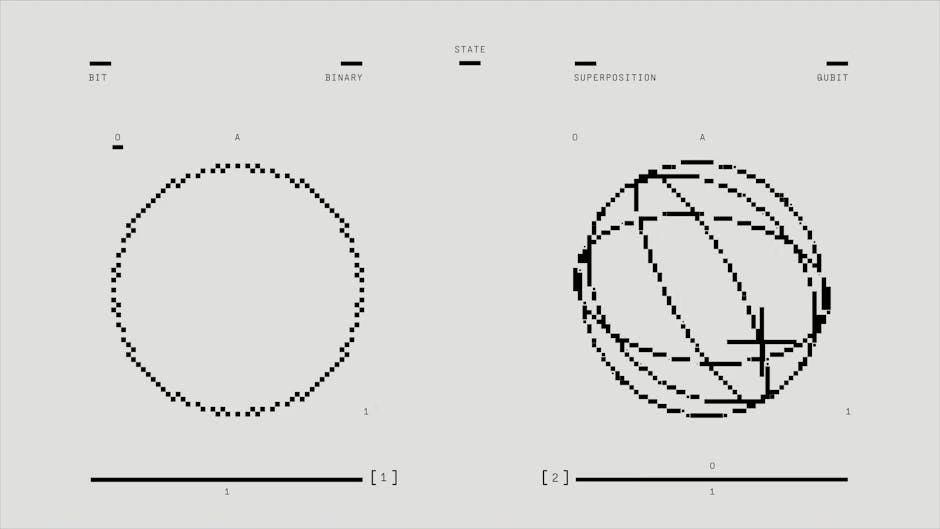
The Majorana 1 chip, recently detailed in Nature, utilizes a novel approach to quantum computing based on Majorana fermions—exotic particles that can exist as their own antiparticles. Unlike traditional quantum bits (qubits) that rely on superconducting circuits or trapped ions, Microsoft’s approach leverages these unique particles to create more stable quantum states.
This stability addresses one of quantum computing’s greatest challenges: maintaining quantum coherence in the face of environmental interference. The Majorana-based approach potentially offers significant advantages in error correction and quantum state preservation, two critical factors limiting current quantum computers.
How It Works
At its core, the Majorana 1 chip works by creating topological qubits. These qubits store information in a fundamentally different way than conventional quantum systems, using the unique properties of Majorana fermions to protect quantum information from decoherence.
The chip incorporates specialized materials and precise fabrication techniques to create the conditions necessary for Majorana fermions to emerge and function as computational elements. This approach represents years of theoretical and experimental work coming to fruition in a practical device.
Challenges Ahead
Despite the promising nature of this breakthrough, Microsoft’s quantum computing path faces significant challenges. The Majorana 1 chip remains in early developmental stages, and scaling the technology to create practical, general-purpose quantum computers will require overcoming substantial engineering hurdles.
Additionally, the field is highly competitive, with companies like IBM, Google, and various startups pursuing alternative quantum computing architectures. Each approach has its own advantages and limitations, creating a complex landscape for quantum computing development.
The Quantum Computing Race
Microsoft’s Majorana 1 chip enters a field increasingly defined by rapid advancement and significant investment. Recent reports indicate massive capital flowing into quantum computing infrastructure, with companies like TSMC announcing multi-billion dollar investments in advanced chip fabrication facilities that could eventually support quantum technologies.
The global race for quantum supremacy continues to accelerate, with both private companies and national governments recognizing the strategic importance of leadership in this transformative technology. Microsoft’s breakthrough represents a significant development in this competitive landscape.
Implications for the Future
If Microsoft’s approach proves successful at scale, it could fundamentally alter the timeline for practical quantum computing applications. More stable qubits would enable larger quantum systems capable of solving previously intractable problems in fields ranging from materials science and drug discovery to cryptography and artificial intelligence.
The Majorana 1 chip may represent just the beginning of a new branch in quantum computing evolution—one that could potentially leapfrog current limitations and accelerate the arrival of quantum advantages in real-world applications.
Conclusion
Microsoft’s Majorana 1 chip stands as a testament to the company’s long-term investment in quantum computing research. While significant work remains before this technology reaches commercial viability, the breakthrough demonstrates that multiple paths toward practical quantum computing continue to advance in parallel.
As the quantum computing landscape evolves, Microsoft’s topological approach using Majorana fermions adds an important new dimension to the field, potentially opening doors to quantum capabilities previously thought to be decades away.
Sources
- Psychopathic prompting here – Reddit Singularity
- OpenAI researcher on Twitter: “all open source software is kinda meaningless” – Reddit Singularity
- Is the Anti-AI and dismissive sentiment from r/PhD exaggerated? – Reddit Singularity
- News 📰 Trump, Chip Maker TSMC Expected to Announce $100 Billion Investment in the US, per WSJ. – Reddit Singularity
- QwQ-32B added to LiveBench: An open source model small enough to run on a 3090 outperforming Claude 3.7 Sonnet on most categories – Reddit Singularity
- Chinese company “Manus” introduces general AI Agent, announces it will be releasing open source soon. – Reddit Singularity
- Stargate plans per Bloomberg article “OpenAI, Oracle Eye Nvidia Chips Worth Billions for Stargate Site” – Reddit Singularity
- Where are all the rumours of new techniques and models from OpenAI? Are they running out of ideas or have the leaks been plugged? – Reddit Singularity
- Open Source is Killing Software Engineers – Reddit Singularity
- GPT 4.5 getting caught in an explicit loop – Reddit Singularity
- ARC 2 looks identical to ARC 1. Humans get 100% on it (early results). – Reddit Singularity
- Let’s suppose consciousness, regardless of how smart and efficient a model becomes, is achieved. Cogito ergo sum on steroids. Copying it, means giving life. Pulling the plug means killing it. Have we explore the moral implications? – Reddit Singularity
- Do you think AI is already helping it’s own improvements? – Reddit Singularity
- Software Developers – Stop worrying and start preparing! – Reddit Singularity
- World’s first “Synthetic Biological Intelligence” runs on living human cells. – Reddit Singularity
- News article: World’s largest call center using AI to ‘neutralize’ Indian employees’ accents – Reddit Singularity
- Empirical evidence that GPT-4.5 is actually beating scaling expectations. – Reddit Singularity
- Well, gpt-4.5 just crushed my personal benchmark everything else fails miserably – Reddit Singularity
- GPT4.5 Review from a physician. This is on a whole other level for non reasoning tasks. – Reddit Singularity