


The Technical Evolution of AI Infrastructure: From Centralized Tools to Distributed Intelligence Systems
The artificial intelligence landscape is undergoing a fundamental architectural transformation that extends far beyond individual applications like ChatGPT or DALL-E. As we advance through 2026, the technical infrastructure supporting AI tools is evolving from centralized, application-specific systems toward distributed, agent-based architectures that promise to redefine how we interact with intelligent systems across multiple domains.
Architectural Paradigm Shifts in AI Systems
The current generation of AI tools operates primarily through centralized cloud architectures, where models like GPT-4 or MidJourney’s diffusion networks process requests through dedicated server farms. However, emerging technical frameworks are challenging this paradigm through hybrid approaches that combine the reliability of centralized systems with the autonomy of distributed networks.
This shift is particularly evident in the development of AI operating systems designed for next-generation devices. Major technology companies are investing heavily in creating middleware architectures that enable AI agents to operate across multiple applications and services without requiring traditional app-based interactions. These systems employ sophisticated orchestration layers that can coordinate between different AI models, manage context switching, and maintain persistent user preferences across diverse computational environments.
Unstructured Data Processing: The Technical Foundation
One of the most significant technical breakthroughs enabling advanced AI tools is the development of robust unstructured data processing pipelines. Traditional AI systems struggled with the heterogeneous nature of enterprise data—comprising text documents, video footage, audio recordings, and sensor data that collectively represent up to 90% of organizational information assets.
Modern AI architectures now employ multi-modal transformer networks capable of processing this diverse data spectrum simultaneously. These systems utilize advanced embedding techniques that can map unstructured content into unified vector spaces, enabling cross-modal analysis and generation capabilities. The technical implementation involves sophisticated attention mechanisms that can weight different data modalities based on context and query requirements.
For instance, in healthcare applications, these systems can now correlate patient imaging data with clinical notes, lab results, and real-time monitoring feeds to provide comprehensive analytical insights. The underlying neural architectures employ hierarchical processing stages that can extract relevant features from each data type while maintaining semantic relationships across modalities.
Web3 Integration and Decentralized AI Architectures
The convergence of AI and Web3 technologies represents a significant technical evolution in how AI tools are deployed and accessed. Unlike traditional centralized AI services, Web3-enabled AI systems utilize blockchain-based consensus mechanisms to coordinate distributed computational resources.
These hybrid architectures employ novel technical approaches such as federated learning protocols that can train AI models across decentralized networks without centralizing sensitive data. The systems utilize cryptographic techniques to ensure model integrity while enabling collaborative training across multiple nodes. This approach is particularly relevant for AI tools that require domain-specific training data that cannot be centralized due to privacy or regulatory constraints.
The technical implementation involves sophisticated peer-to-peer networking protocols that can dynamically allocate computational resources based on demand and availability. Smart contracts manage the economic incentives for resource providers while ensuring quality of service through reputation-based scoring systems.
Agent-Based AI Systems: Technical Implementation Challenges
The development of AI agents capable of autonomous action across multiple applications presents significant technical challenges in system integration and context management. These systems require sophisticated state management architectures that can maintain user context across different services while ensuring security and privacy.
The technical architecture typically employs a multi-layered approach where high-level intent recognition systems parse user requests, planning modules generate action sequences, and execution engines coordinate with external APIs and services. The challenge lies in creating robust error handling and fallback mechanisms that can gracefully manage failures in complex, multi-step operations.
Advanced implementations utilize reinforcement learning techniques to improve agent performance over time, with reward functions designed to optimize for user satisfaction while minimizing resource consumption and error rates. The systems must also implement sophisticated privacy-preserving techniques to ensure that sensitive user data is not inadvertently shared across service boundaries.
Performance Optimization and Scalability Considerations
As AI tools become more sophisticated and ubiquitous, the technical challenges of scaling these systems become increasingly complex. Modern AI architectures must balance computational efficiency with model capability, often employing techniques such as model quantization, pruning, and knowledge distillation to optimize performance.
Edge computing integration represents a critical technical development, where AI models are distributed across local devices and cloud infrastructure to minimize latency and improve responsiveness. This requires sophisticated model partitioning techniques that can dynamically allocate different computational tasks based on available resources and network conditions.
The implementation of these distributed systems also requires advanced monitoring and observability frameworks that can track performance across multiple deployment environments while providing actionable insights for system optimization.
Future Technical Directions
The evolution toward more sophisticated AI tools will likely be characterized by increased modularity and interoperability. Technical standards for AI model interfaces and data exchange protocols are emerging, enabling more seamless integration between different AI systems and services.
Research into neuromorphic computing architectures and quantum-enhanced machine learning algorithms suggests that the next generation of AI tools may operate on fundamentally different computational substrates, potentially offering exponential improvements in both performance and energy efficiency.
As these technical foundations mature, we can expect AI tools to become increasingly specialized while maintaining the ability to collaborate and share insights across different domains and applications, ultimately creating a more integrated and capable artificial intelligence ecosystem.
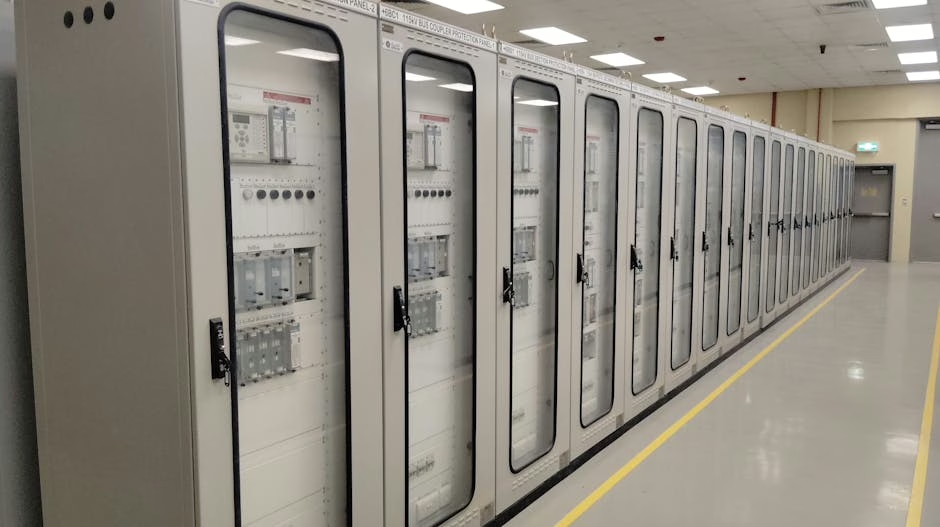
Photo by Shameer Vayalakkad Hydrose on Pexels
