
The National Highway Traffic Safety Administration opened a federal investigation on June 22, 2026 into a Tesla Model 3 crash in a Houston suburb that killed a 76-year-old after the vehicle struck a residential home — the driver told local authorities he was using Tesla’s partially automated driving systems at the time. The case is the latest in a string of NHTSA scrutiny that now spans more than a decade of incidents tied to Tesla’s driver-assistance technology.
NHTSA Opens New Tesla Autopilot Investigation
The NHTSA has opened more than three dozen Tesla special crash investigations involving partially automated driving systems since 2016, according to CNBC’s June 22 report. The Houston-area fatality adds to a pattern regulators have tracked across Tesla’s Autopilot and Full Self-Driving Supervised features, both of which require the driver to remain attentive and ready to intervene.
Tesla Vice President of Autopilot Ashok Elluswamy responded to the incident on X, noting in a post that Tesla’s supervised system “requires you to pay attention to the road and be ready to take over at all times.” The statement reflects Tesla’s standard legal and communications posture: classify the product as driver-assistance, not full autonomy, and place responsibility on the operator.
The distinction matters legally. NHTSA’s special crash investigation program does not automatically trigger a recall, but findings can escalate into formal engineering analysis and, ultimately, defect determinations. Tesla has previously faced recall actions tied to Autopilot behavior, including a 2023 recall covering roughly 2 million vehicles that pushed an over-the-air software update to add additional driver-monitoring alerts.
What Tesla’s Assisted Driving Systems Actually Do
Tesla markets two partially automated products: Autopilot, included on all new vehicles, and Full Self-Driving (Supervised), available as a subscription or one-time purchase. Neither system is certified for unsupervised operation on public roads in the United States. Both use a camera-only sensor suite — Tesla removed radar from its vehicles in 2021 — combined with onboard neural networks to handle steering, acceleration, and braking within defined conditions.
Critics, including some former NHTSA officials, have argued that the product names overstate capability and contribute to driver over-reliance. Tesla has consistently disputed that characterization, pointing to aggregate safety statistics it says show lower crash rates per mile for vehicles using Autopilot versus the national average. Those figures have been contested by safety researchers who note the comparison does not control for road type, speed, or driving conditions.
Regulatory Pressure on Autonomous and Semi-Autonomous Vehicles
The Tesla probe arrives as federal oversight of automated driving systems is becoming more structured. NHTSA finalized its Automated Driving Systems reporting rule in 2021, requiring manufacturers to disclose crashes involving Level 2 and above automation within one day if an airbag deployed or a fatality occurred. That rule produced a flood of data showing Tesla accounts for the large majority of reported incidents — partly because Tesla has by far the largest fleet of vehicles with active driver-assistance features on U.S. roads.
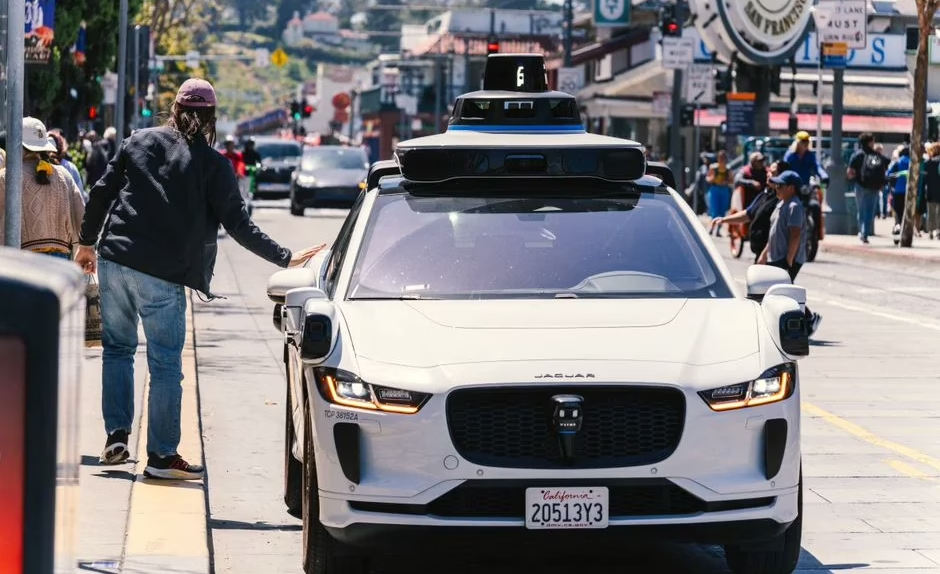
Waymo, which operates a fully driverless commercial robotaxi service in San Francisco, Los Angeles, and Phoenix, operates under a different regulatory framework. Its vehicles are classified as Level 4 autonomous — no human driver required within defined geographic areas — and face separate state-level permitting requirements alongside NHTSA oversight. Waymo has reported significantly fewer serious crashes per mile than the national human-driver average, though its operational domain is more constrained than general public road use.
The contrast between Tesla’s high-volume, driver-supervised model and Waymo’s geofenced, fully autonomous approach represents the two dominant commercialization strategies in the U.S. market as of mid-2026.
ADAS Safety Debates Intensify Industry-Wide
The Houston crash renews a broader debate about how advanced driver-assistance systems (ADAS) should be named, marketed, and monitored. SAE International’s automation levels — ranging from Level 0 (no automation) to Level 5 (full automation) — provide a technical taxonomy, but those levels are not legally binding labels in the U.S., and automakers have wide latitude in how they describe features to consumers.
Ford’s BlueCruise, GM’s Super Cruise, and Mercedes-Benz’s Drive Pilot have each taken different approaches to driver monitoring and operational design domains. Mercedes received Level 3 certification in Nevada and California for Drive Pilot, which legally allows the driver to divert attention under specific highway conditions up to 40 mph — the first such approval for a production vehicle in the U.S. Tesla has not sought Level 3 certification for any of its systems.
NHTSA has proposed, but not yet finalized, rules that would require minimum performance standards for automatic emergency braking and lane-keeping systems across all new passenger vehicles. The agency’s ability to move quickly has been constrained by staffing and budget pressures.
What This Means
The federal probe into the Houston fatality is unlikely to produce immediate consequences for Tesla — NHTSA investigations at the special crash level take months to years to resolve. But the cumulative weight of more than three dozen such investigations since 2016 creates a documentary record that regulators, plaintiffs’ attorneys, and Congress can draw on.
More broadly, the incident highlights the unresolved tension at the center of the ADAS market: systems capable enough to attract consumer adoption, but not capable enough to operate without sustained human oversight — and marketed in ways that may erode that oversight in practice. As Tesla’s fleet grows and its FSD Supervised feature reaches more drivers, the statistical exposure to edge-case failures increases proportionally.
For the wider automotive AI sector, the regulatory trajectory points toward stricter naming conventions, mandatory driver-monitoring hardware, and more granular crash reporting. Automakers building next-generation ADAS features into 2027 and 2028 model-year vehicles are doing so with the knowledge that the compliance bar is likely to rise before those vehicles reach end-of-life.
FAQ
What triggered the new NHTSA investigation into Tesla?
NHTSA opened the investigation after a Tesla Model 3 crashed into a Texas home on or before June 22, 2026, killing a 76-year-old resident. The driver reported to local authorities that Tesla’s partially automated driving system was active at the time, according to CNBC.
How many Tesla Autopilot crash investigations has NHTSA opened?
NHTSA has opened more than 36 Tesla special crash investigations involving partially automated driving systems since 2016, per CNBC’s June 22 reporting. These investigations cover incidents involving both Autopilot and Full Self-Driving Supervised features.
What is the difference between Tesla FSD and Waymo’s autonomous system?
Tesla’s Full Self-Driving (Supervised) is a Level 2 system requiring a licensed driver to remain attentive and ready to intervene at all times. Waymo operates Level 4 vehicles in defined geographic areas with no human driver required, under separate state permits and NHTSA oversight.
Related news
- Hackers steal Apple and Tesla data from Tata’s iPhone factory – Apple Insider
Sources
- Tesla faces federal probe after Model 3 slams into Texas home, killing 76-year-old – CNBC Tech
- The $400 million machine powering the future of chipmaking – MIT Technology Review
- The running list: major tech layoffs in 2026 where employers cited AI – TechCrunch
- How Businesses Are Building Specialized AI They Can Trust – NVIDIA AI Blog
- Google’s online dominance is showing signs of cracking in AI era – CNBC Tech