
Tesla launched its Full Self-Driving system in China on May 21, 2026, ending years of regulatory delays, while General Motors simultaneously cut more than 600 IT positions to hire AI-specialized engineers — two data points that define how deeply artificial intelligence is now reshaping automotive strategy. The moves arrive as Ford, GM, and Stellantis have collectively shed more than 20,000 U.S. salaried jobs this decade, a figure CNBC calculated is tied in large part to technology-driven workforce restructuring.
Tesla FSD Finally Reaches China in May 2026
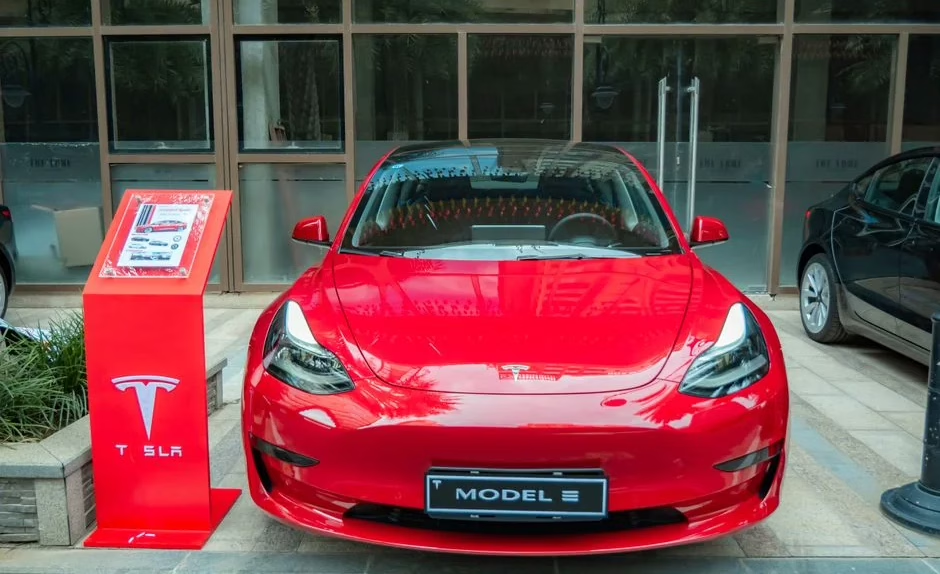
Tesla made Full Self-Driving available in China on May 21, 2026, pricing the system at a one-time fee of 64,000 Chinese yuan ($9,409) on its Model 3 sedan. The launch came after years of regulatory delays, during which Chinese domestic EV brands had already rolled out proprietary self-driving technologies at scale. Tesla announced the expansion on X, listing China among 10 markets where FSD is now available.
According to CNBC’s reporting, hiring activity in China had fueled speculation about the launch before Tesla confirmed availability. The timing is significant: Tesla is entering a market where competitors including BYD, Xpeng, and Huawei-backed brands have spent years accumulating real-world data and refining driver-assistance stacks. Tesla’s FSD entry gives it a foothold, but the company is not arriving as the first mover it was in the United States.
The China launch also carries strategic weight beyond software revenue. FSD data collected from Chinese roads could accelerate model training, though Tesla must navigate data-localization requirements that have historically complicated foreign tech deployments in the country.
GM Trades 600 IT Roles for AI-Native Talent
General Motors laid off more than 10% of its IT department — roughly 600 salaried employees — in a deliberate skills swap, according to TechCrunch Mobility. GM stated it is actively backfilling those positions with candidates who have AI-focused backgrounds, though the exchange is unlikely to be one-to-one, meaning a net job loss is probable.
The roles GM is recruiting for include:
- AI-native development and model training
- Data engineering and analytics
- Cloud-based engineering
- Agent and model development
- Prompt engineering and AI workflow design
GM is also deploying AI tools to accelerate vehicle design and autonomous vehicle development, according to Automotive News via Google News. The distinction GM is drawing internally is between employees who use AI as a productivity add-on versus those who can build AI systems from the ground up — designing pipelines, training models, and engineering the underlying infrastructure.
Ford, GM, Stellantis: 20,000 Jobs Cut This Decade
The three Detroit automakers have cut a combined 19% of their combined U.S. salaried workforces from recent employment peaks, a total exceeding 20,000 positions, CNBC reported. While multiple factors drive these reductions — EV transition costs, slowing demand, and margin pressure among them — technological change including AI adoption is a consistent thread across all three companies.
The scale of displacement is not matched by equivalent AI hiring. TechCrunch Mobility noted that anecdotes from engineers and founders suggest not all automotive companies have a clear strategy for what they are doing with AI, even as they accelerate investment. The gap between AI spending and AI execution remains a real risk for incumbents competing against software-first rivals.
Samsara’s Fleet AI Shows a Working Revenue Model
Not every automotive AI story is about workforce disruption or autonomous vehicle timelines. Samsara has spent a decade equipping commercial trucks with in-cab cameras for driver monitoring, theft prevention, and liability documentation — and has now turned that data into a proprietary AI model, according to TechCrunch Mobility.
The model can detect potholes and road hazards from camera feeds across millions of vehicles, giving fleet operators infrastructure intelligence that was previously unavailable at scale. Samsara’s approach illustrates what a viable commercial AI use case looks like in transportation: a large proprietary dataset, a specific operational problem, and a direct revenue link. That combination is harder to replicate than it appears, and it separates companies with genuine AI products from those still experimenting.
RJ Scaringe Raises $400M for Industrial AI Startup
Rivian founder RJ Scaringe has raised more than $12.3 billion across three startups in under a decade, and investor appetite has not slowed. His newest venture, Mind Robotics — an industrial AI and robotics company — closed a $400 million round, according to TechCrunch.
Scaringe also founded Also, an electric micromobility startup, in 2025, which has raised more than $300 million with DoorDash among its backers. Eclipse partner Jiten Behl, who led rounds in both Also and Mind Robotics, described Scaringe’s pitch style to TechCrunch: “When RJ explains a certain issue, topic, opportunity, vision, he just has this very unique ability to communicate it so effectively, and it comes across so credible. He’s not trying to undersell the difficulty or oversell the opportunity, and that’s an art.” Scaringe holds a doctorate in mechanical engineering from MIT.
What This Means
The automotive AI story in May 2026 is not a single narrative — it is three overlapping ones running simultaneously. Tesla’s China FSD launch demonstrates that regulatory patience eventually pays off, but the competitive window it once held has narrowed considerably as Chinese rivals built their own systems in the interim. GM’s IT restructuring shows that incumbents are making hard, concrete bets on AI talent rather than simply adding AI tools to existing workflows. And Scaringe’s fundraising streak suggests that investors see the intersection of robotics, AI, and mobility as a durable opportunity regardless of how the EV market cycles.
The common thread is that AI is no longer a future consideration for automotive — it is an active determinant of which companies can attract capital, which can retain engineering talent, and which can compete in markets where software capability is as important as hardware quality. The 20,000-job figure across Detroit’s three largest automakers is the clearest signal yet that this transition has moved past the planning stage.
FAQ
What is Tesla Full Self-Driving and how much does it cost in China?
Full Self-Driving is Tesla’s advanced driver-assistance system that handles highway and city driving with driver supervision. In China, Tesla priced FSD at a one-time fee of 64,000 yuan ($9,409) on the Model 3, as of its May 2026 launch.
Why is GM laying off IT workers if it is investing in AI?
GM is replacing generalist IT roles with positions requiring AI-native skills — model training, data engineering, and agent development — rather than simply reducing headcount. The company has stated it is actively hiring for these roles, though the swap is unlikely to be one-to-one, meaning net job losses are expected.
Who is RJ Scaringe and what is Mind Robotics?
RJ Scaringe is the founder of Rivian and a serial entrepreneur who has raised over $12.3 billion across three ventures. Mind Robotics is his latest startup, focused on industrial AI and robotics, which closed a $400 million funding round in 2025–2026 with Eclipse among its lead investors.
Sources
- Tesla brings ‘Full Self-Driving’ to China after years of delays as local EV rivals race ahead – CNBC Tech
- TechCrunch Mobility: The AI skills arms race is coming for automotive – TechCrunch
- GM deploys AI tools to speed vehicle design and autonomous vehicle development – Automotive News – Google News – AI Tools
- Frederiek Toney, Ford’s former customer service and logistics lead, has died, leaving behind a defining legacy – Automotive Logistics – Google News – Logistics
- RJ Scaringe has raised more than $12B across three startups and investors still want more – TechCrunch