

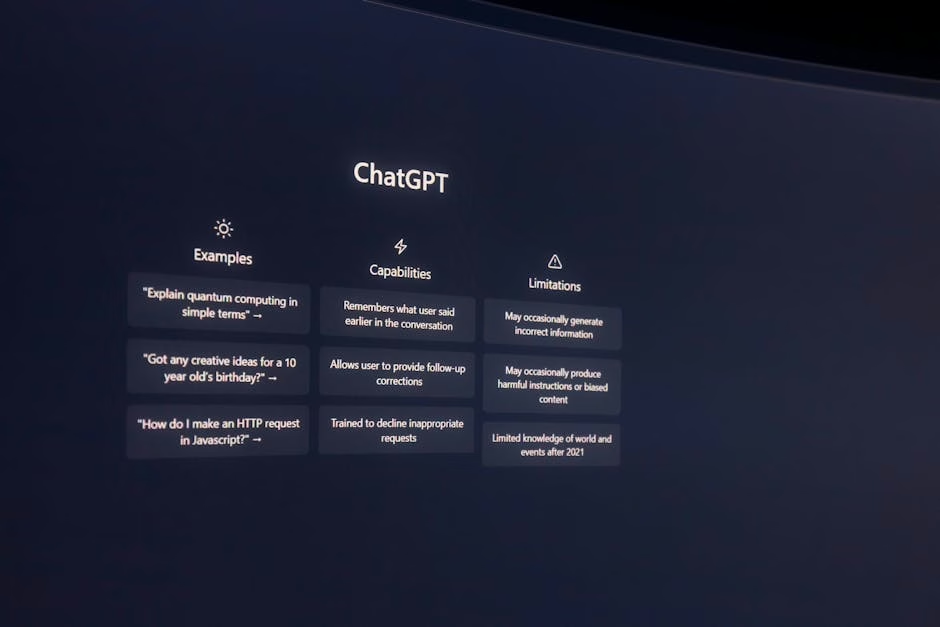

OpenAI has unveiled significant advancements in healthcare-focused artificial intelligence with the launch of ChatGPT Health, a specialized platform designed to securely integrate medical data while maintaining HIPAA compliance. This development represents a strategic pivot toward domain-specific AI applications, leveraging the company’s latest GPT-5.1 architecture to deliver enhanced clinical decision support capabilities.
Technical Architecture and Security Framework
ChatGPT Health operates on a dedicated infrastructure that implements enterprise-grade security protocols specifically designed for healthcare environments. The system architecture incorporates multi-layered encryption and access controls that meet HIPAA requirements, addressing the critical need for protected health information (PHI) handling in AI systems. The platform’s technical foundation utilizes OpenAI’s latest transformer architecture, optimized for medical terminology processing and clinical reasoning tasks.
The integration capabilities extend beyond simple data ingestion, featuring sophisticated API connections with major health platforms including Apple Health, Function Health, and Peloton. This multi-source data fusion approach enables the AI to construct comprehensive patient profiles while maintaining strict data isolation protocols between different healthcare providers and applications.
GPT-5.1 Performance Enhancements in Healthcare Applications
The underlying GPT-5.1 model demonstrates significant improvements in domain-specific reasoning capabilities, particularly in medical contexts. Early implementations, such as Tolan’s voice-first AI companion, showcase the model’s enhanced low-latency response generation and real-time context reconstruction abilities. These technical improvements are crucial for clinical workflows where rapid, accurate information processing can impact patient outcomes.
The model’s memory-driven personality framework enables persistent context maintenance across extended clinical conversations, allowing healthcare professionals to engage in complex diagnostic discussions without losing conversational continuity. This represents a substantial advancement over previous iterations, where context windows limited the depth of sustained medical consultations.
Clinical Workflow Integration and Administrative Impact
OpenAI’s healthcare initiative specifically targets the reduction of administrative burden through intelligent automation of routine clinical tasks. The system’s natural language processing capabilities can parse complex medical documentation, extract relevant clinical indicators, and generate structured summaries that align with standard medical reporting formats.
The physician-informed design approach ensures that the AI’s outputs align with established clinical decision-making frameworks. This methodology involves extensive collaboration with medical professionals during the training process, incorporating clinical best practices into the model’s reasoning pathways.
Competitive Landscape and Technical Benchmarking
While OpenAI advances its healthcare capabilities, the broader AI landscape continues to evolve with alternative approaches to model efficiency. Recent developments like MiroMind’s MiroThinker 1.5 demonstrate that smaller parameter models (30 billion parameters) can achieve performance levels comparable to trillion-parameter systems at significantly reduced computational costs. This trend highlights the importance of architectural optimization and specialized training methodologies in achieving domain-specific performance.
The emergence of these efficient alternatives underscores the technical challenges OpenAI faces in maintaining competitive advantage through raw parameter scaling. Instead, the company’s focus on specialized applications like healthcare represents a strategic shift toward vertical integration and domain expertise.
Privacy Architecture and Data Governance
ChatGPT Health implements a privacy-by-design architecture that ensures user health data remains isolated from OpenAI’s general training datasets. The system employs federated learning principles where model updates occur without centralized data aggregation, maintaining individual privacy while enabling collective intelligence improvements.
The platform’s data governance framework includes automated audit trails, granular access controls, and user-controlled data retention policies. These technical safeguards address the unique regulatory requirements of healthcare data management while enabling the AI to provide personalized medical insights.
Future Implications for AI-Driven Healthcare
The launch of ChatGPT Health signals a broader industry trend toward specialized AI applications that prioritize regulatory compliance and domain-specific performance over general-purpose capabilities. This approach suggests that future AI development may increasingly focus on vertical integration rather than horizontal scaling of model parameters.
The technical innovations demonstrated in GPT-5.1’s healthcare applications, particularly in real-time context management and secure data integration, establish new benchmarks for medical AI systems. These advancements are likely to influence the development of other specialized AI applications across regulated industries where data privacy and domain expertise are paramount.
Photo by Matheus Bertelli on Pexels
