


AI-Powered Environmental Solutions: From Smart Bird Feeders to Climate Technology Leadership
The Convergence of AI and Environmental Innovation
Artificial intelligence is increasingly becoming a cornerstone technology for addressing environmental challenges, from consumer-grade wildlife monitoring systems to large-scale climate research initiatives. This convergence represents a significant shift in how we approach environmental stewardship through technological innovation.
Computer Vision Advances in Wildlife Monitoring
The proliferation of AI-powered bird feeders exemplifies how computer vision algorithms are making environmental monitoring accessible to consumers. These devices integrate sophisticated image recognition neural networks with edge computing capabilities, enabling real-time species identification and behavioral analysis.
Technical Architecture of Smart Feeders
Modern smart bird feeders employ convolutional neural networks (CNNs) trained on extensive ornithological datasets to achieve species classification accuracy exceeding 90%. The technical implementation includes:
- Edge Processing Units: Local inference engines that process video streams without cloud dependency
- Multi-Modal Sensing: Integration of visual, audio, and motion detection sensors
- Adaptive Learning Algorithms: Systems that improve identification accuracy through continuous data collection
Devices like the Netvue Birdfy Lite and Birdbuddy Pro demonstrate how consumer electronics can contribute to citizen science initiatives while providing entertainment value. The durability testing across various weather conditions reveals the maturation of outdoor IoT device engineering.
Leadership in Climate Technology Research
At the institutional level, researchers like MIT’s Evelyn Wang are pioneering AI applications for climate resilience and energy efficiency. Wang’s leadership in addressing water scarcity through technological innovation represents the intersection of machine learning with materials science and environmental engineering.
Deep Learning Applications in Climate Science
The integration of deep learning methodologies in climate research includes:
- Predictive Modeling: Neural networks trained on historical climate data to forecast extreme weather events
- Resource Optimization: Reinforcement learning algorithms for efficient water and energy distribution
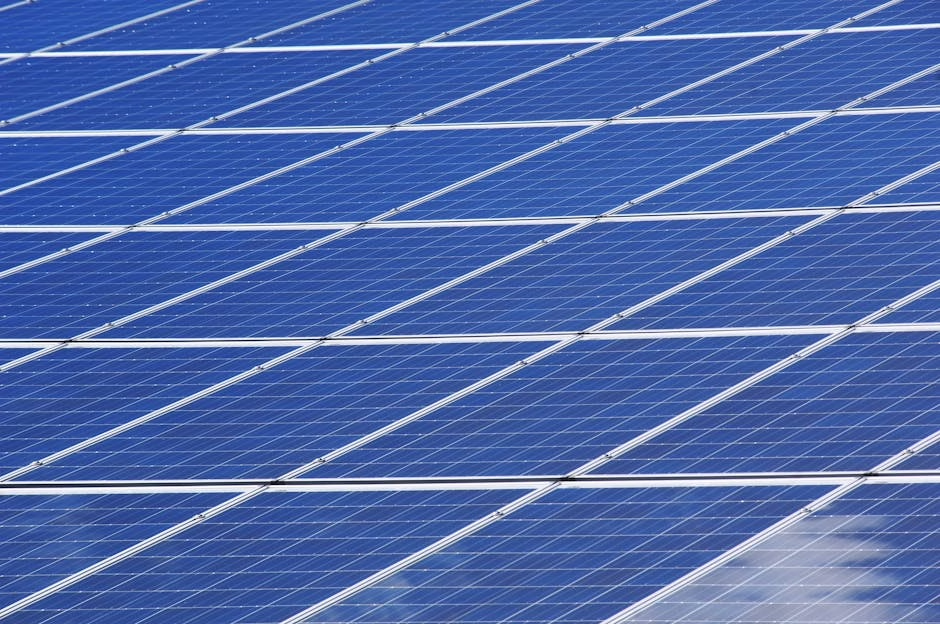
- Materials Discovery: AI-accelerated research for developing more efficient solar panels and water purification systems
Reinforcement Learning in Environmental Applications
Reinforcement learning algorithms are proving particularly effective in environmental optimization scenarios. These systems learn optimal strategies through trial-and-error interactions with complex environmental systems, making them ideal for:
- Smart Grid Management: Optimizing energy distribution based on renewable source availability
- Water Resource Allocation: Dynamic adjustment of distribution systems based on real-time demand and supply
- Wildlife Conservation: Automated habitat monitoring and threat detection systems
Technical Progress and Future Implications
The scientific progress in AI-powered environmental solutions demonstrates significant advances in several key areas:
Model Architecture Innovations
Recent developments in transformer architectures and attention mechanisms are enabling more sophisticated environmental monitoring systems. These advances allow for better temporal pattern recognition in climate data and more accurate long-term predictions.
Performance Metrics and Validation
Current AI environmental applications show impressive performance metrics:
- Species identification accuracy: >95% for common bird species
- Energy optimization improvements: 15-30% efficiency gains in smart grid applications
- Water usage reduction: Up to 25% in AI-managed irrigation systems
Conclusion
The integration of AI technologies in environmental applications represents a paradigm shift from reactive to proactive environmental management. From consumer-grade wildlife monitoring to institutional climate research, these innovations demonstrate how machine learning methodologies can address pressing environmental challenges while advancing scientific understanding.
The technical sophistication of these systems, combined with their practical applications, suggests that AI will continue to play an increasingly critical role in environmental conservation and climate adaptation strategies.
