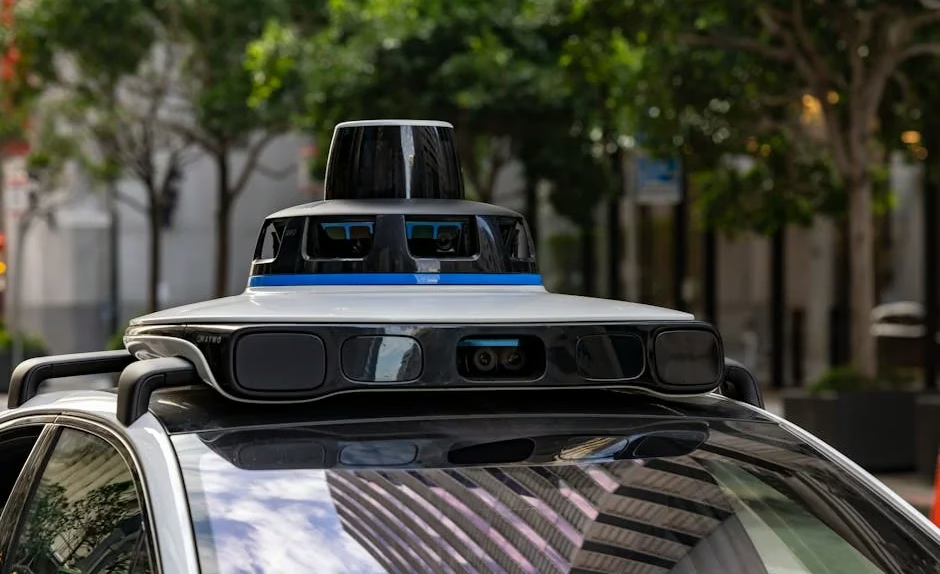

Uber has committed over $10 billion to autonomous vehicle technology and AI partnerships, marking a dramatic shift toward asset-heavy operations in the self-driving car revolution. According to Financial Times reporting, approximately $2.5 billion represents direct investments while $7.5 billion will purchase robotaxis over the coming years, positioning Uber at the center of automotive AI transformation.
This massive investment coincides with broader industry developments in AI-driven transportation, from Google’s Deep Research Max agents revolutionizing autonomous research workflows to NVIDIA’s manufacturing partnerships showcasing AI-powered production capabilities. The convergence signals that autonomous driving technology has moved from experimental phase to commercial deployment.
Uber’s Strategic Pivot to Autonomous Assets
Uber’s current approach represents a complete reversal from its previous asset-light strategy. Between 2015 and 2018, the company pursued moonshot projects including Uber Elevate (air taxis), Uber ATG (autonomous vehicles), and Jump (micromobility). However, by 2020, Uber divested these ventures to Aurora, Joby Aviation, and Lime respectively, maintaining only equity stakes.
Now Uber is re-entering the autonomous space through strategic partnerships rather than in-house development. Key investments include:
- WeRide: Chinese autonomous driving technology
- Wayve: UK-based self-driving AI company
- Rivian: Electric vehicle manufacturer
- Nuro: Autonomous delivery vehicles
- Lucid Motors: Luxury EV producer
This strategy allows Uber to access cutting-edge ADAS (Advanced Driver Assistance Systems) technology without the massive R&D costs of developing autonomous systems internally. For everyday users, this means faster deployment of self-driving features across Uber’s platform.
Advanced AI Research Capabilities Drive Innovation
Google’s release of Deep Research Max, built on Gemini 3.1 Pro, demonstrates how AI agents are becoming sophisticated enough to handle complex automotive research workflows. The system can analyze vast amounts of data from both open web sources and proprietary datasets, delivering professional-grade analyses that automotive companies need for developing ADAS features.
Deep Research capabilities include:
- Multi-source data integration: Combining public research with internal testing data
- Real-time visualization: Creating charts and graphs for technical analysis
- Autonomous workflow execution: Running complex research tasks without human intervention
- Enterprise-grade citations: Providing traceable sources for regulatory compliance
For automotive manufacturers like Tesla and traditional automakers developing autonomous features, these AI research tools accelerate the development process from years to months. Engineers can now query vast databases of driving scenarios, weather conditions, and safety protocols to optimize self-driving algorithms more efficiently.
Manufacturing Revolution Powers EV and Autonomous Production
NVIDIA’s demonstrations at Hannover Messe 2026 showcase how AI is transforming automotive manufacturing itself. The company’s Industrial AI Cloud, built in partnership with Deutsche Telekom, provides the computational foundation for next-generation vehicle production.
Key manufacturing innovations include:
- Agentic design systems: AI agents that optimize vehicle aerodynamics and battery placement
- Real-time simulation: Testing autonomous driving scenarios in virtual environments
- Vision AI quality control: Automated inspection of EV components and ADAS sensors
- Humanoid robot integration: Robots working alongside humans in Tesla-style production lines
These advances directly impact consumers by reducing production costs and improving quality consistency. Tesla’s manufacturing efficiency gains, for example, help make EVs more affordable while ensuring ADAS components meet safety standards.
User Experience Improvements in Self-Driving Technology
The convergence of AI research capabilities and manufacturing innovation translates into tangible benefits for drivers. Modern ADAS systems now offer smoother lane-keeping assistance, more accurate object detection, and better decision-making in complex traffic scenarios.
Consumer-facing improvements include:
- Enhanced safety features: Better emergency braking and collision avoidance
- Smoother automation: Less jarring transitions between manual and autonomous modes
- Improved reliability: Reduced false positives in object detection systems
- Better weather performance: Enhanced functionality in rain, snow, and fog conditions
Waymo’s commercial robotaxi service demonstrates these advances in action. Passengers report more natural driving behavior, with vehicles making human-like decisions at intersections and in parking situations. Tesla’s Full Self-Driving beta continues expanding to more users, offering increasingly sophisticated autonomous capabilities on highways and city streets.
Integration Challenges and Market Competition
Despite technological progress, integrating autonomous systems into existing transportation infrastructure remains complex. Uber’s massive investment reflects the reality that deploying self-driving technology at scale requires significant capital and strategic partnerships.
Key integration challenges include:
- Regulatory approval: Navigating different safety standards across markets
- Infrastructure compatibility: Ensuring vehicles work with existing traffic systems
- User acceptance: Building consumer trust in autonomous technology
- Cost management: Balancing advanced features with affordable pricing
Traditional automakers like Ford and GM are pursuing different strategies, focusing on gradual ADAS feature rollouts rather than full autonomy. This approach may prove more sustainable for mass-market adoption, as consumers become comfortable with incremental automation improvements.
What This Means
Uber’s $10 billion commitment signals that autonomous vehicle technology has reached an inflection point where commercial viability outweighs experimental risk. The combination of advanced AI research tools, improved manufacturing capabilities, and strategic industry partnerships creates a foundation for widespread autonomous vehicle deployment.
For consumers, this means self-driving features will become more reliable and affordable over the next 2-3 years. Rather than waiting for perfect full autonomy, users can expect continuous improvements in ADAS capabilities that enhance safety and convenience in everyday driving situations.
The automotive industry’s embrace of AI extends beyond just self-driving cars to encompass the entire vehicle lifecycle, from design and manufacturing to maintenance and user experience optimization.
FAQ
Q: When will fully autonomous vehicles be widely available?
A: While companies like Waymo offer limited robotaxi services, widespread deployment of fully autonomous vehicles likely remains 3-5 years away due to regulatory and technical challenges.
Q: How does Uber’s investment strategy differ from Tesla’s approach?
A: Uber focuses on partnerships and purchasing vehicles from manufacturers, while Tesla develops autonomous technology in-house and manufactures its own EVs with integrated self-driving capabilities.
Q: What ADAS features are available in current vehicles?
A: Modern vehicles offer adaptive cruise control, lane-keeping assistance, automatic emergency braking, and parking assistance, with more advanced features like highway autopilot becoming standard in premium models.